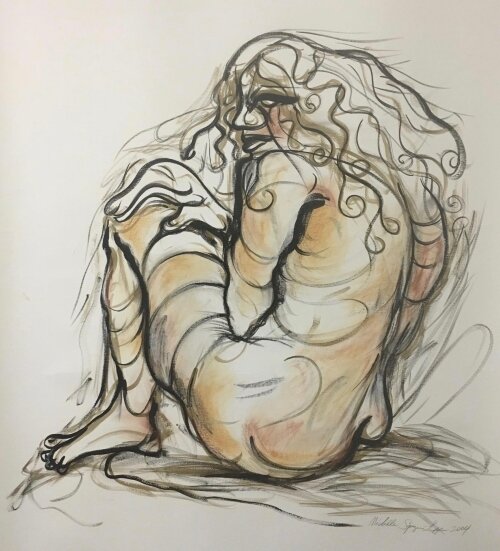

Welcome to the second issue of Galdrar, where writers and artists create pieces based on a musical stimulus. For Issue #2, we are going a little darker and dissecting Sergei Rachmaninoff’s The Isle of the Dead, Op. 29 through the artwork of Michelle Spiziri.
About the Composer
Sergei Vasilyevich Rachmaninoff was a Russian composer and pianist born in 1873. He took up piano at the age of four and graduated from the Moscow Conservatory in 1892. Following the negative criticism of his debut symphony in 1897, Rachmaninoff quit composing for four years. However, after successful therapy, he returned to music and composed his second piano concerto in 1901, which was enthusiastically received by critics and audiences alike. While Rachmaninoff spent most of the next sixteen years in Dresden, Germany, he eventually moved to New York City. For the last 25 years of his life, Rachmaninoff gave several piano and conducting performances around the United States. He eventually passed away from melanoma in 1943, just one month after receiving U.S. citizenship.
The Stimulus
Rachmaninoff finished this composition in 1908. Written in A minor, The Isle of the Dead was inspired by a black and white reproduction of a painting with the same name by Arnold Böcklin. Rachmaninoff saw the reproduction on display in Paris in 1907 and loved its dark tone. However, when he saw the original version, he was disappointed stating, “If I had seen first the original, I, probably would have not written my Isle of the Dead. I like it in black and white.”
The symphonic poem is written in 5/8 time, which emulates both breathing and the rowing of oars. As the theme builds in intensity, it feels like the oars slogging through the water. The anticipation builds until the island is revealed and the subjects of the painting arrive at their final destination. Through this piece, Rachmaninoff invokes the duality of life and death.
Rooted by Michelle Spiziri

Striking Woman by Michelle Spiziri